Est. 2024 · Toronto, Canada
Your restaurant POS was built before Uber Eats existed.
Ours was built after.
What follows is why this company exists, what it refuses to become, and where to check that against the contract rather than against the page.
The math that started this
Reservation software puts a price on the guest who came back.
A restaurant does not make its money on strangers. It makes it on the people who come back.
Software that charges per cover puts a price on that return visit. It did not earn the guest, it did not cook for them, and it was not in the dining room when they came back.
The more successful a restaurant becomes, the more it pays for reservation software. Fill more tables, higher bill. Better hospitality, bigger fees. Grow, and the costs scale against you.
Per-cover fees are a success tax, and the industry accepted them as normal.
We didn’t.
Dashi charges a flat monthly fee per location. No per-cover fees, at any volume. A full Saturday and a quiet Tuesday cost the same. A busy Saturday belongs to the operator who worked it. Your costs stay predictable, your guest list stays yours, and a good month stops arriving with a larger invoice attached.
Your rent doesn’t rise when the dining room fills, and neither does your software bill.
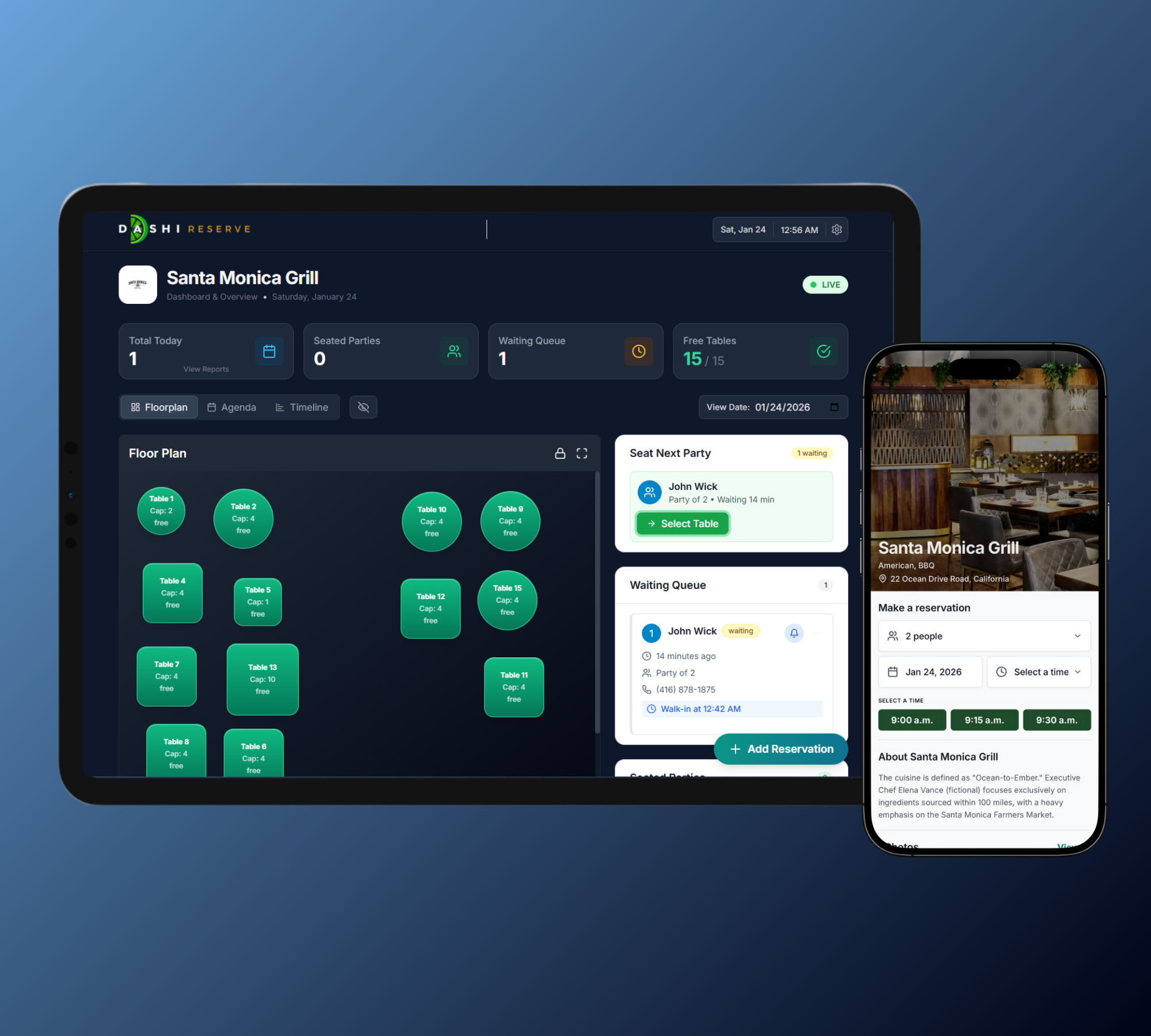
Dashi plans start at $99 CAD per month per location. Hardware and payment processing are billed separately. Some integrations and features depend on your configuration and platform availability.
What we refuse to become
Your guest data, and what our contract actually lets us do with it.
These are clauses in our merchant terms, not lines on a marketing page. The section numbers are here so you can check the document instead of the page.
We won't treat your guest list as ours to decide about.
In the merchant terms you are the controller and Dashi is the processor. In plain language: you decide what happens to your guest data, and we process it on the instructions you set in the product. That is the allocation Canadian accountability principles expect, and it is the sentence everything below depends on.
We won't sell your guest data, or use it to market a competing restaurant to your guests.
Every email, phone number, dietary note and anniversary belongs to the restaurant that earned it. There is a Dashi side to this and you should know where the line sits: if a guest signs up for a Dashi account or a Dashi loyalty page themselves, they have a relationship with us as well as with you. That does not move your guest data to us, and it does not let us put a competing restaurant in front of your guests.
Read the clause before you believe us.
We won't pass your numbers to another restaurant without your say-so.
The clause does let us build city-level and neighbourhood-level benchmarks out of aggregated, de-identified data, and we would rather you read that than find it later. What the same clause forbids: re-identifying a guest, handing guest-identifiable data to another merchant, and showing your identifiable competitive metrics to another merchant without your permission.
The name, and what it rules out
We are named after a broth, and it rules things out.
The name comes from the Japanese broth that sits under everything else on the plate. It does its job without competing with the dish. That is the job we want the software to do while your dining room is full.
A metaphor is only useful if it rules things out. This one rules out becoming the fifth system your staff has to learn. If a feature only works because somebody opens another tablet, it is not connected to your restaurant, it is sitting next to it.
Why I started Dashi
Restaurant technology forgot who it works for.
I’m Mahrad Shahi. I’m from Toronto, and I started Dashi after getting curious about the restaurant technology market and looking closely at how the industry makes money.
I kept finding the same pattern. Restaurants operate on thin margins, while their software adds long contracts, processing costs, hidden fees, and another charge whenever a basic feature is needed.
Per-cover pricing was the clearest example. The software stores a party size of one or six, then charges the restaurant more for the six. The software did not seat those people. The restaurant did.
The deeper problem was that every part of the restaurant lived in a different system. Reservations knew one piece. The POS knew another. Delivery and online ordering knew something else. That makes useful analysis almost impossible because no single-purpose tool can see the whole relationship.
So I started building Dashi as one connected restaurant system. The point is not to put more features under one logo. It is to connect the information so an operator can understand what happened, see what deserves attention, and act on it.
When our first restaurant went live, I was on the floor teaching the staff and listening to what concerned them. That experience set the rule for the company: the restaurant stays at the centre, and the technology works for it.
Dashi is Moneris® certified and has live production access to Uber Eats, DoorDash, and Skip. You can also ask for a reference call before switching.
Mahrad Shahi, founder of Dashi
What we do during the changeover
We carry the risk of switching.
- Your old system stays live for thirty days.
- We migrate your menu ourselves.
- Someone from Dashi is in your dining room for your first Friday.
- You get a named person whose phone is answered while service is running.
- Month to month after that, so we have to keep earning it.
See what switching would look like
We don’t take a cut ofyour good nights.
Bring your menu and your station setup. We will show you what the changeover looks like on your floor, and what your bill would be at your volume.
Nobody goes back to a restaurant because they loved its software. They go back because they loved the restaurant.
The full room is yours. The regulars are yours. The list of everyone who ever ordered from you or booked a table is yours.
See Dashi Reserve on your floor plan
Flat monthly pricing. No per cover fees.