
OpenTable Alternatives in Canada: The Complete 2026 Guide
Looking for a better restaurant reservation system in Canada? Compare the top platforms on pricing, guest intelligence, and data ownership to protect your margins.
If you run a restaurant in Canada, you already know what reservation software costs you. The per-cover fees, the monthly base, the locked guest data — it adds up fast. This guide breaks down the five major reservation platforms available to Canadian operators in 2026, with real pricing, honest trade-offs, and a side-by-side comparison so you can make the right call for your dining room.
The question isn't whether you need a reservation system — it's whether your current one is working for you, or against you.
TL;DR — The 30-Second Version
- →OpenTable charges $149–$499+/mo plus $0.25–$1.50 per cover. A busy restaurant on a mid-tier plan can pay $25,000–$40,000+/year.
- →Resy is flat-fee but $249–$899 USD/mo, US-headquartered, and primarily built for the American market.
- →SevenRooms was acquired by DoorDash in 2025. Your guest data now sits inside a delivery company. $499+/mo.
- →Tock was acquired by Amex and is being merged into Resy. Future uncertain. Charges 3% on prepayments.
- →Dashi Reserve is $149/mo flat. Zero per-cover fees. You own 100% of your guest data.
The Shifting Landscape of Canadian Hospitality
Operating a restaurant in Canada has never been a low-stakes endeavor. Operators face rising prime costs, thin margins, and highly competitive local markets. According to data from Restaurants Canada, the average pre-tax profit margin for independent full-service restaurants in Canada sits between 3% and 5%.
When margins are that tight, every single dollar of revenue matters. Yet, legacy reservation software continues to take a significant cut through a transaction-based pricing model that scales in the wrong direction. The busier your dining room gets, the more you are penalized.
This dynamic has forced a major industry shift. Independent operators, multi-concept groups, and high-volume dining rooms are actively looking for an OpenTable alternative Canada can rely on, a system built to support operators rather than tax them.
The Cost of Convenience: The Per-Cover Dilemma
How did we get here? When reservation platforms first entered the market, they offered a genuine convenience: moving physical reservation books online. To make the software appealing to operators, they introduced transaction-based pricing, commonly known as the per-cover model.
Under this model, a restaurant is charged a base monthly software fee, plus a variable fee for every guest booked. The standard rates are brutal:
- Monthly subscription: $149–$499+ USD depending on plan tier (Basic, Core, Pro).
- Network covers (~$1.00–$1.50 per person): Diners found through OpenTable’s marketplace, apps, or partner sites.
- Direct covers (~$0.25 per person): Bookings through the restaurant’s own website widget or Google profile.
At first glance, a dollar per guest seems negligible. But let's look at how this scales for a typical mid-sized restaurant seating 2,000 covers a month:
| Monthly Covers | Blended Cover Fees (~$0.75 avg) | Monthly Cost (Core plan, $299 base) | Annualized Expense |
|---|---|---|---|
| 500 covers | $375 | $674 | $8,088 |
| 1,500 covers | $1,125 | $1,424 | $17,088 |
| 3,000 covers | $2,250 | $2,549 | $30,588 |
| 5,000 covers | $3,750 | $4,049 | $48,588 |
Think about what that annual expense represents. It represents a line cook's salary, an upgraded kitchen station, a premium wine program, or crucial marketing dollars. In the hospitality business, success should be celebrated, not taxed.

The 5 Canadian Contenders Compared 🇨🇦
If you are ready to move away from legacy cover-fee networks, there are five major reservation options available to Canadian operators today. Here is an honest, strategic look at how they stack up.
1. Dashi Reserve
RecommendedMonthly
$149
Per Cover
$0.00
Data
100% Yours
Dashi Reserve is built for independent Canadian restaurants. Flat subscription, zero per-cover fees, and absolute guest data ownership. Your guest relationships stay yours — Dashi never cross-promotes competitors.
- True Flat Pricing: $149/month regardless of volume.
- Deep POS Integration: Native connection to loyalty, KDS, and online ordering — explore the full restaurant POS feature set.
- Toronto-Based Support: Real, local support for Canadian operators.
2. OpenTable
Monthly
$149–$499+
USD, tiered
Per Cover
$0.25–$1.50
Data
Platform Owns
The legacy giant with the largest consumer network. But that network comes with a catch — OpenTable treats your guests as their users, cross-promoting competitor restaurants to your own diners via automated emails.
- Tiered Pricing + Cover Fees: $149–$499/mo base + $0.25 (direct) to $1.50 (network) per cover.
- No Relationship Ownership: Diner emails masked or locked inside their ecosystem.
- Competitor Promotion: Actively directs your regulars to other restaurants.
3. Resy
Monthly
$249–$899
USD
Per Cover
$0.00
Data
Restricted
Owned by American Express but does not require Amex payment processing - restaurants keep their existing POS and payment terminals. Popular with trendy, high-concept restaurants in Toronto and Montreal. No per-cover fees, but priced entirely in USD, which adds a 35-40% currency premium for Canadian operators.
- Premium USD Pricing: Expensive for Canadian operators due to exchange rate.
- USD-Only Pricing: All plans billed in US dollars, adding significant cost for Canadian restaurants.
- No POS Integration: Requires separate tablets at the host stand, with no native delivery integration or unified order flow.
4. SevenRooms (Now owned by DoorDash)
Monthly
$499+
USD
Per Cover
$0.00
Data
DoorDash Owns
Acquired by DoorDash for $1.2 billion in June 2025. Previously positioned as operator-first with full data ownership, but your guest data now sits inside a delivery marketplace company. Powerful CRM and marketing automation, but the ownership question has fundamentally changed.
- DoorDash Ownership: Guest data now answers to a delivery company, not you.
- Enterprise Pricing: $499+/mo with annual contracts typical.
- High Friction Setup: Requires weeks of onboarding and database migration.
5. Tock (Being merged into Resy)
Monthly
$199-$399
USD
Per Cover
0%-3%
on prepays
Data
Amex Owns
Founded by Nick Kokonas and acquired by American Express in October 2024. Amex also owns Resy, and is actively merging Tock into the Resy platform (expected summer 2026). Excellent for prepaid tasting menus and ticketed events, but its future as a standalone product is uncertain.
- Being Absorbed: Amex is merging Tock into Resy - uncertain future for standalone users.
- Transaction Commissions: Up to 3% on all prepayments and deposits.
- Niche Model: Built for ticketed events, not standard table management.
Feature Comparison Matrix
To help you make the best decision for your dining room, here is a transparent look at how the top reservation systems stack up side-by-side:
| Platform | Monthly Cost | Per-Cover Fee | Data Ownership | POS Integration | Setup Time |
|---|---|---|---|---|---|
| Dashi Reserve | $149 flat | $0.00 | 100% (Absolute) | Native (All-in-One) | Instant (Self-serve) |
| OpenTable | $299 base (Core plan) | $1.00 - $1.50 | No (Network owns) | Basic (Requires API) | Complex (Needs rep) |
| Resy | $249 - $899 USD | $0.00 | Restricted | Limited integrations | Moderate |
| SevenRooms (DoorDash) | $499+ base | $0.00 | DoorDash owns | Requires Middleware | Very High (Weeks) |
| Tock (Amex → Resy) | $199 - $399 base | 0% - 3% on prepays | Amex owns | Siloed system | Merging into Resy |
Beyond the Fees: Data Ownership & Guest Intelligence
Pricing is the most visible difference, but the true wedge is what happens behind the scenes with your customer relationships. The concept of "guest intelligence" is heavily marketed and over-promised in restaurant technology today. Many enterprise software brands frame it as a list of abstract corporate features: CRM databases, customer segmentation engines, or automated email workflows.
But operators do not need corporate SaaS jargon. They do not want complex database software that requires hours of manual maintenance. What they want is very simple: **they want repeat visits, and they want their team to make every customer feel recognized.**
"Hospitality is remembering. When your software remembers for you, the host stand becomes the smartest seat in the room."
Dashi Reserve approaches guest intelligence from a values standpoint, not a feature list. We prioritize service emotion over software emotion, built around three core beliefs:
1. Hospitality Is Remembering
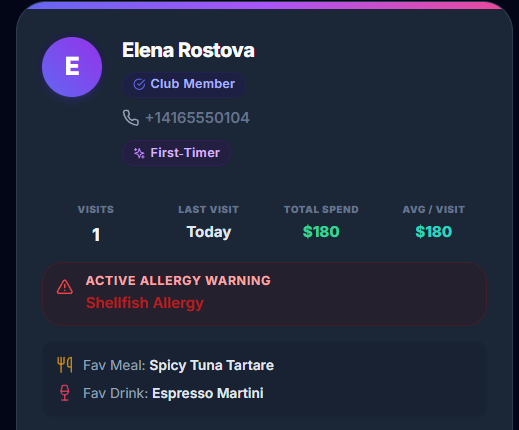
Real hospitality is the magic of recognition. When Table 4 is sat, the host should see instantly: "Mike's wife has a severe shellfish allergy and their anniversary is March 14." That specific, human detail — surfaced through a purpose-built guest intelligence platform — is infinitely more valuable than a generic system tag.
2. Your Guest Data Is Yours
The relationship between you and your guests belongs entirely to you. Legacy platforms withhold diner emails or use your data to suggest neighbor competitors. With Dashi Reserve, your guest database is completely yours — export cleanly with zero hassle, anytime.
3. Turn First-Timers into Regulars (Automatically)
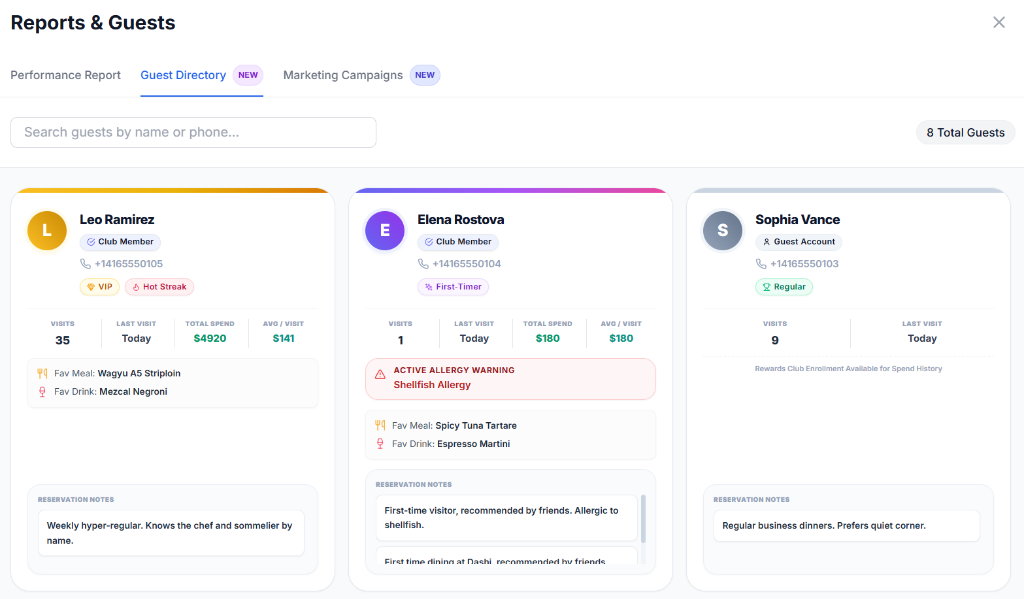
Dashi's guest intelligence is completely integrated into the broader POS and loyalty stack. The reservations build the profile, the POS records their dining habits, and automated SMS reminders reactivate them. Every transaction makes the next service smarter.

The Math of Margins: Flat-Fee vs. Per-Cover Systems
Let's run a complete mathematical proof comparing a variable per-cover system (using standard rates) to Dashi Reserve's flat-fee model. This demonstrates the financial realities of restaurant technology in 2026.
$1.50 per cover. Every. Single. Guest.
Your bestselling Saturday costs you the most.
They profit from your packed dining room.
 The Dashi Way
Starting from $149/month.
Seat 200 or 2,000, the price stays the same.
We win when you win, not because you win.
The Mathematical Case Study
Consider a busy downtown Toronto venue doing an average of 3,000 covers per month (approximately 100 covers per night).
Platform A (Legacy Per-Cover)
Base Fee: $149–$499/month
Cover Fees (assuming 1,500 app covers at $1.50, and 1,500 site covers at $0.25): $2,625/month
Total Monthly Cost: $2,974/month
Annual Cost: $35,688
Platform B (Dashi Reserve)
Base Subscription: $149/month
Cover Fees: $0.00/month
Total Monthly Cost: $149/month
Annual Cost: $1,788
Net Cash Savings
$33,900/year
For a multi-location restaurant group operating three sites, that represents **more than $100,000 of direct bottom-line cash** kept inside your operating account. That is the margin difference between surviving and thriving in today's economy. See our transparent pricing to calculate your own savings.
The Operator's Playbook: How to Transition Smoothly
The biggest friction keeping operators locked into high legacy fees is the fear of transition. They worry about losing historical guest notes, disrupting existing bookings, or confusing host staff.
However, moving to a modern flat-fee system is far simpler than legacy sales representatives claim. Here is the step-by-step transition playbook:
Secure Your Guest Database
Under Canadian data protection laws, you have a legal right to export your guest data. Request a clean CSV export containing guest names, emails, phone numbers, and historical booking notes from your current provider.
Import & Cleanse
Upload your guest database cleanly into Dashi Reserve. Our automated import tools map customer names, VIP history, and preferences (such as allergies or specific seat requests) instantly, organizing your database with zero manual entry.
Embed the Diner Flow
Replace your booking widget code. Dashi's high-fidelity reservation widget embeds natively on your site, keeping your guests fully inside your domain rather than redirecting them to third-party marketplaces.
Configure SMS confirmations
Set up automated SMS confirmation sequences. This is the single most effective way to reduce restaurant no-shows, keeping your reservation lines active and automatically filling late cancellations from your waitlist.
Dashi provides full transition support. Our Toronto-based setup team handles the CSV migration, layout mapping, and widget installation for your website, ensuring you transition cleanly without losing a single reservation or guest record.
The Bottom Line
A restaurant is more than a building; it is a collection of memories and human relationships. The software you use to manage those relationships should be a tool that serves your dining room, not a platform that taxes your success.
By switching to a transparent, flat-fee reservation system like Dashi Reserve, you protect your hard-earned margins, take back absolute ownership of your guest data, and empower your team to offer genuine, memorable hospitality at scale.
It is time to stop paying the cover tax.
Take back control of your dining room today.

Ready to take back control?
Join the Canadian restaurants switching to flat-fee reservations. Own your guest data, protect your margins, and upgrade your hospitality.